Statutory minimum notice period: the table your employer owes you
Updated September 2026
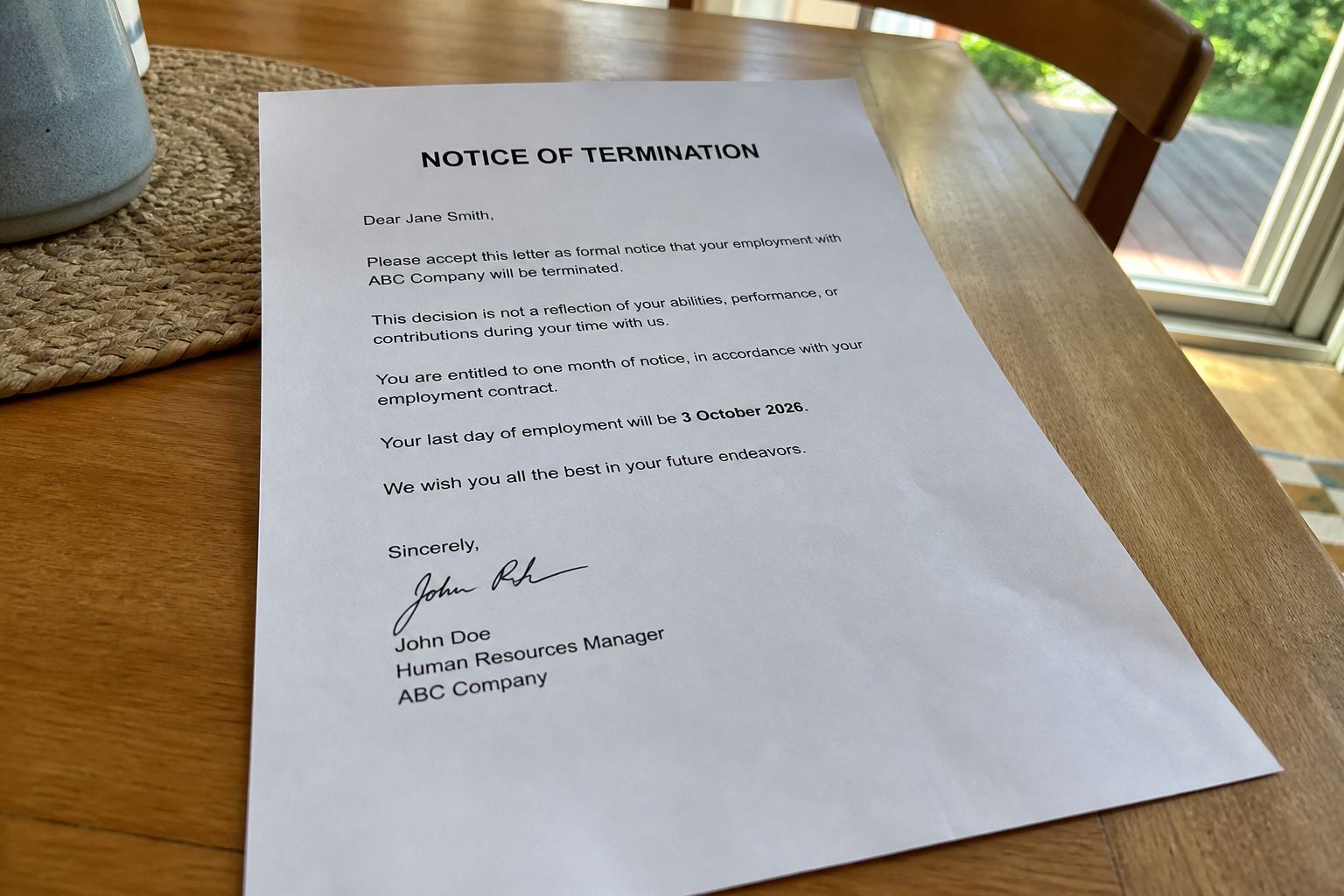
One week's statutory notice for every complete year of service, up to a cap of twelve weeks: that's the legal minimum every employer owes, whatever your contract says and whatever your manager tells you on the way out. Plenty of people assume "one week's notice" is simply the standard no matter how long you've worked there, but the law sets a rising scale instead.
Work out your notice
What the statutory minimum actually is
Section 86 of the Employment Rights Act 1996 sets a floor for how much notice an employer must give an employee before ending their employment. This is old, settled law, it isn't part of the current wave of reform, and it applies whether or not your contract mentions notice at all. The same section also sets a minimum for notice going the other way, from you to your employer, though that side of the rule is simpler: after one month's service, you owe at least one week, regardless of how long you've been there.
The table
| Length of continuous employment | Statutory minimum notice from employer |
|---|---|
| Less than 1 month | No statutory minimum (check your contract) |
| 1 month up to 2 years | 1 week |
| 2 complete years | 2 weeks |
| 3 complete years | 3 weeks |
| 4 complete years | 4 weeks |
| 5 complete years | 5 weeks |
| 6 complete years | 6 weeks |
| 7 complete years | 7 weeks |
| 8 complete years | 8 weeks |
| 9 complete years | 9 weeks |
| 10 complete years | 10 weeks |
| 11 complete years | 11 weeks |
| 12 or more complete years | 12 weeks (this is the cap) |
The pattern is simple once you see it: one week per complete year of service, stopping at twelve weeks even if you've been there for twenty years. Nothing in the current reforms touches this scale. It sits underneath everything else as a baseline that can't be bargained down.
Statutory minimum versus contractual notice
Your contract can promise more than the table above. Plenty do, especially for senior or long-serving staff, where three or six months' notice is common. Whatever the contract says, you're entitled to the higher of the two figures, the statutory minimum or the contractual one, never the lower. So if your contract says two weeks but you've clocked up five complete years, you're still owed five weeks, because the statutory floor overrides a contract term that falls short of it. If your contract is silent on notice altogether, the statutory table simply fills the gap.
One thing the table doesn't cover: garden leave, payment in lieu of notice, and how notice interacts with your final pay date are all separate questions, often set out in the contract itself rather than by statute, so read your own paperwork carefully or get it checked before assuming how it applies to you.
The employer owes you this too
It's easy to think of notice periods as something only employees have to worry about, but the obligation runs both ways. If your employer dismisses you with less than the statutory minimum and doesn't pay you in lieu of it, that's a breach of contract, and it can be worth pursuing regardless of how the dismissal itself is characterised. This matters most where things end abruptly, redundancy announced with no warning, a summary dismissal that turns out not to be justified, or a resignation forced by your employer's own conduct (a constructive dismissal). In all of these situations, the effective date of termination is what starts any clock running on a claim, so it's worth pinning that date down precisely rather than guessing.
If your notice was short-changed
A claim for unpaid notice is usually a breach of contract claim, and like most employment claims it has a time limit. Claims over acts occurring before 1 October 2026 stay on the older three-months-less-a-day limit; those over acts from that date onward move to six months less a day, as set out in the recent transitional rule, explained in full on our timeline of the Employment Rights Act 2026 changes. In Scotland, breach of contract claims switch to six months later, on 9 November 2026, according to the government's implementation timeline. Because the correct deadline depends on exactly when your notice period ended or your dismissal took effect, and because Acas early conciliation pauses that clock while it runs, it's worth working the actual date out rather than assuming. Our employment tribunal deadline calculator factors in both the transitional cutoff and the Acas stop-the-clock rule, so you can see your real deadline rather than a rough guess. That's also the right place to start if the dispute involves constructive dismissal, since the clock there runs from your resignation's effective date, not the date of the breach that caused it, and our deadline calculator handles that distinction too.
If your notice pay dispute overlaps with a wider dismissal claim, our employment tribunal deadline calculator is the place to work out the actual deadline that applies to you, rather than relying on the notice table alone.
Quick answers
- How much statutory notice does my employer owe?
- After one month, one week; then one week per complete year of service from year two, capped at 12 weeks (Employment Rights Act 1996 s.86).
- Can my contract give less than the statutory minimum?
- No. A contract can only improve on those floors.
- How much notice do I owe if I resign?
- After one month, the statutory employee minimum is one week, unless your contract requires more.