The Employment Rights Act changes, explained plainly
Updated 28 September 2026
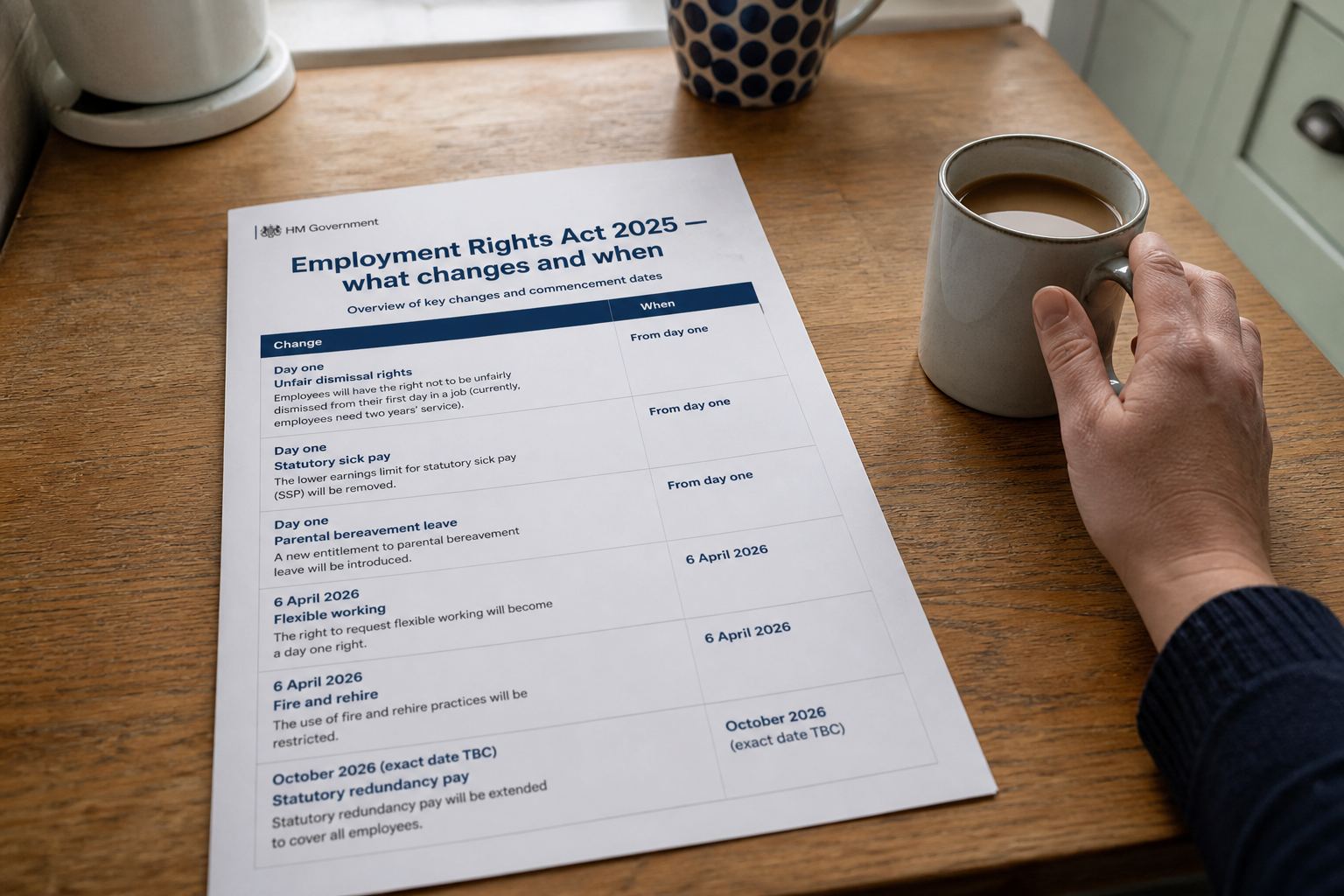
The Employment Rights Act 2025 is coming into force in stages through 2026 and 2027 rather than all at once, and it's easy to lose track of which right started when. Here's the practical version, dated, from the employee's side, based on the government's implementation timeline as updated on 25 September 2026. Future dates can still move.
The dates that matter
| Date | What changed |
|---|---|
| 1 December 2025 | Acas early conciliation window extended from 6 to 12 weeks. |
| 18 February 2026 | Stronger protection against dismissal for taking part in industrial action. |
| 6 April 2026 | Paternity leave and unpaid parental leave became day-one rights (the service and earnings tests for statutory paternity pay did not change). Statutory sick pay became payable from the first day off, with no minimum earnings. Reporting sexual harassment can count as whistleblowing. The maximum protective award for collective redundancy failures doubled. |
| 7 April 2026 | The Fair Work Agency was set up. |
| 1 October 2026 | Tribunal claim time limit extends from 3 months to 6 months, but only for acts occurring on or after this date. For breach of contract claims in Scotland, the change comes on 9 November 2026. |
| 30 October 2026 | Employers must take all reasonable steps to prevent sexual harassment, and must not permit harassment by customers, clients and other third parties. New trade union measures, including a stronger right of access to workplaces. |
| By the end of 2026 | Tipping law strengthened (see tips at work). |
| January 2027 | Unfair dismissal qualifying period cut from 2 years to 6 months where employment ends on or after 1 January 2027, and the cap on the compensatory award removed. Fire and rehire protections. A new duty to tell workers about their right to join a trade union. |
| April 2027 | Bereavement leave of up to two weeks, unpaid, including for pregnancy loss before 24 weeks. |
| Autumn 2027 | Flexible working: a meeting before any refusal, and refusals only where reasonable. |
| Also in 2027 (no month given) | Enhanced dismissal protection for pregnant women and new mothers; for zero-hours workers, guaranteed hours, reasonable notice of shifts and payment for short-notice changes (timing to follow consultation); limits on non-disclosure agreements in harassment and discrimination cases; a new collective redundancy consultation threshold; regulation of umbrella companies. |
The unfair dismissal change is not what was first announced
Early coverage of the Employment Rights Bill described day-one unfair dismissal protection, meaning no qualifying period at all. What actually passed into the Employment Rights Act 2025 is a reduction of the qualifying period to 6 months, a real strengthening from the previous 2-year threshold but not the full day-one right originally floated. If you're relying on older articles for this specific point, they're describing an earlier draft, not the final Act.
The Act received royal assent on 18 December 2025, and its provisions commence in stages. For this change the date is now fixed in law: the Employment Rights Act 2025 (Commencement No. 4 and Transitional and Saving Provisions) Regulations 2026 bring the six-month qualifying period, and the removal of the cap on the compensatory award, into force on 1 January 2027. They apply where the effective date of termination is on or after that day. Our page on the unfair dismissal time limit covers the filing clock.
Why this matters for your own timeline
If something happens at work now, in the second half of 2026, the tribunal deadline that applies depends on exactly which side of 1 October your situation falls, and if you're facing a dismissal question, whether your employment ends before or after 1 January 2027 changes what protection you have at all. Use the deadline calculator to work out your specific filing window once you know your dates.
What hasn't changed
Statutory redundancy pay calculations, the basic award for unfair dismissal, and most discrimination protections under the Equality Act remain on their existing framework, apart from the harassment changes in the table. The cap on the unfair dismissal compensatory award is due to go in January 2027, alongside the six-month qualifying period. This rollout adds and adjusts specific rights and timing; it isn't a wholesale rewrite of employment law.
This is a general summary of publicly announced dates and changes, not legal advice. Implementation details can shift before each date takes effect; confirm anything time-sensitive with Acas or a solicitor.
Quick answers
- When does the tribunal time limit become six months?
- For acts or EDTs on or after 1 October 2026. Earlier dates stay on three months less a day. For breach of contract claims in Scotland, the change comes on 9 November 2026.
- Is unfair dismissal now a day-one right?
- No. What passed is a cut of the qualifying period from two years to six months, not day-one. It applies to dismissals where the effective date of termination is on or after 1 January 2027. Automatically unfair reasons, such as whistleblowing or pregnancy, already need no qualifying period.
- When did paternity leave become day-one?
- 6 April 2026, for paternity leave and unpaid parental leave. Statutory Paternity Pay still needs 26 weeks' service and minimum earnings.