The time limit for a whistleblowing claim in 2026
Updated August 6, 2026
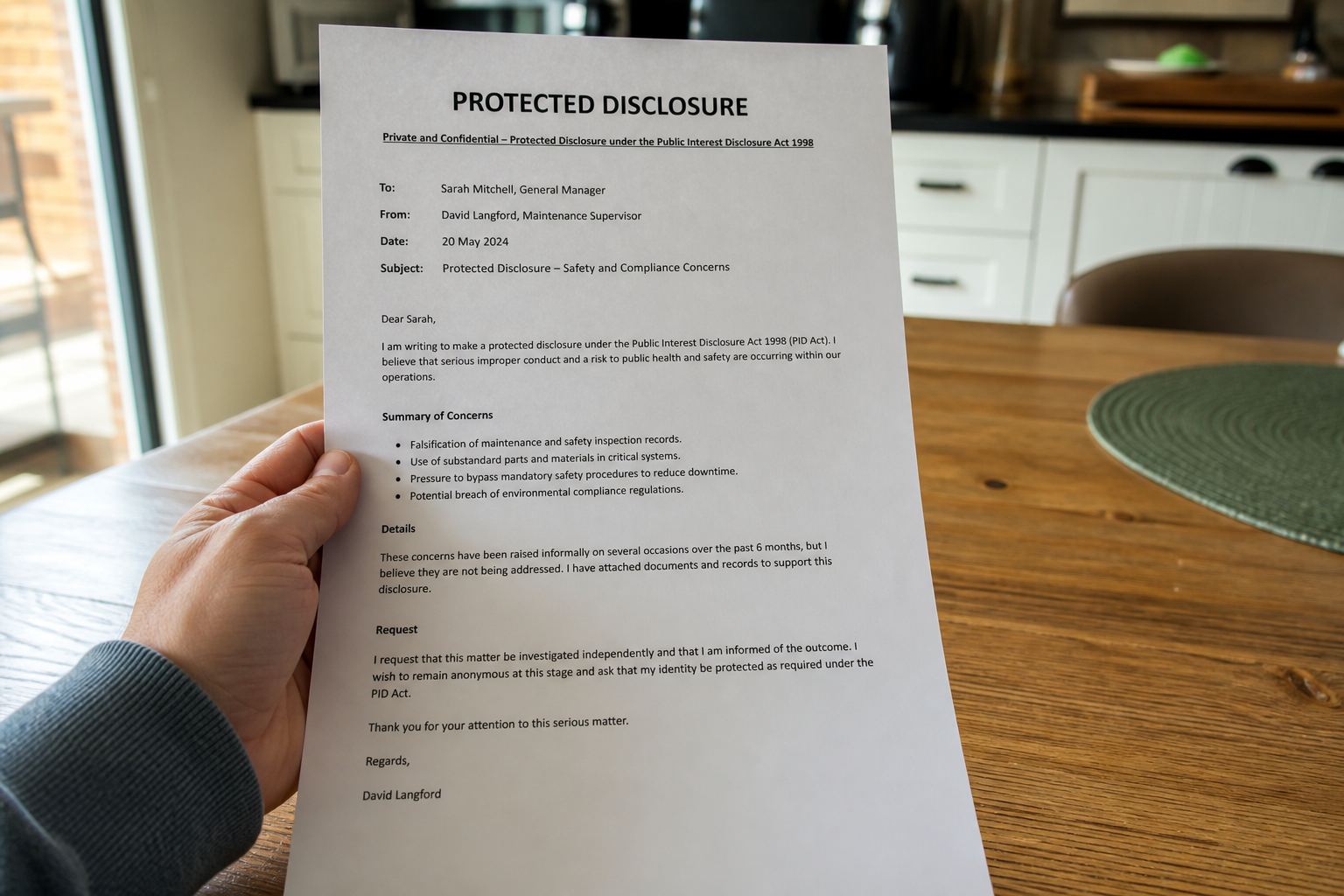
1 October 2026 is the date that decides which time limit applies to your whistleblowing claim. Write down the exact date of the dismissal, or the date of the treatment you're complaining about, then check whether it falls before or after that cutoff. After that, contact Acas for early conciliation straight away: you generally can't lodge a tribunal claim without going through it first, and starting it pauses your clock while it runs.
Whistleblowing claims sit on the same clock as unfair dismissal
If you're dismissed for making a protected disclosure, that's automatically unfair dismissal under the whistleblowing provisions, and it's treated the same way as any other unfair dismissal claim for time-limit purposes. The standard tribunal time limit has always been three months less a day from the relevant date. From 1 October 2026 that extends to six months less a day, under the Employment Tribunal (Extension of Time Limits) (Miscellaneous Amendments and Transitional Provisions) Regulations 2026, which name whistleblowing explicitly among the claim types covered, alongside unfair dismissal, discrimination, TUPE, and Working Time Regulations breaches.
The transitional rule, and why your date matters more than the filing date
The extension isn't a blanket six months for everyone filing after 1 October 2026. Regulation 10 ties the new period to when the act or failure you're complaining about happened, not to when you happen to submit your claim. If the dismissal or detriment occurred before 1 October 2026, you're on the old three-months-less-a-day regime, even if you're reading this well into next year. If it happened on or after 1 October 2026, you get the full six months less a day. For a while, both regimes will be running side by side, and it's easy to assume the newer, longer rule applies to your situation when it doesn't. Our explainer on the Employment Rights Act changes sets out the wider timeline if you want the context.
Dismissal for whistleblowing versus detriment while you're still employed
Whistleblowing law actually gives you two separate routes, and it matters which one applies to you. If you were sacked because you blew the whistle, that's the automatic unfair dismissal route described above, and the clock runs from your effective date of termination. If you're still employed but you've been passed over for promotion, excluded, disciplined, or otherwise treated badly because you raised a protected disclosure, that's a detriment claim instead. Detriment claims run on the same three-months-less-a-day period (six months less a day from 1 October 2026, subject to the same transitional rule), but the clock starts from the date of the act or failure complained of, or, where you've suffered a series of similar treatment, from the last act in that series. Get the wrong starting date and you can talk yourself out of time you actually still have.
Working out your effective date of termination
If you were dismissed with notice, your effective date of termination is generally the date your notice period ends, not the date you were told you were being dismissed. If you were dismissed without notice, it's the date of the dismissal itself. If you resigned in response to how you were treated after blowing the whistle, that's a constructive dismissal, and for time-limit purposes it's treated the same as any other dismissal: the clock runs from when your resignation takes effect, not from the date of the original treatment that pushed you out. Statutory minimum notice, separate from any longer notice period in your contract, is set out below.
| Length of service | Statutory minimum notice |
|---|---|
| 1 month to 2 years | 1 week |
| 2 to 12 years | 1 week per complete year of service |
| 12 years or more | 12 weeks (maximum) |
Because the exact date on which your clock starts running is so easy to get wrong, and because it decides which regime you're on either side of 1 October 2026, it's worth running your own dates through the employment tribunal deadline calculator rather than working it out by hand. It applies the transitional rule and the Acas stop-the-clock adjustment automatically.
Acas early conciliation still comes first
Almost all tribunal claims, whistleblowing ones included, need to go through Acas early conciliation before they can be lodged, with only narrow exemptions. Contacting Acas stops your limitation clock while conciliation is underway, and you're guaranteed at least one extra month after your Acas certificate date to file, even if you'd nearly run out of time when you started. Since 1 December 2025 the conciliation window itself can run up to 12 weeks, up from six, so this isn't a small pause. To start it, go to acas.org.uk, submit the early conciliation notification (or call), and you'll be given a unique reference number. A conciliator then has a fixed window to try to resolve things between you and your employer, and you'll get a certificate once that window closes, which you'll need before your claim can proceed.
What counts as a protected disclosure, briefly
Not every complaint at work is whistleblowing in the legal sense. A protected disclosure generally means you reasonably believed you were exposing something like a criminal offence, a breach of a legal obligation, a danger to health and safety, environmental damage, or a cover-up of any of those, and you disclosed it in the right way, to the right person or body, for the disclosure to qualify for protection. If you're not sure whether what you raised meets that bar, that's a separate question from the time limit one, and it's worth getting specific advice on it before you go further.
If you're close to a deadline
Don't wait to be certain about every detail before you act. Contacting Acas is quick, it's free, and it's the step that actually protects your position by pausing the clock. Working out the precise date can wait until after you've started early conciliation; missing the window because you spent too long checking can't be undone.
A whistleblowing dismissal claim and a whistleblowing detriment claim run on the same length of time limit but can start their clocks on different dates, and both sit inside whichever regime, three months less a day or six months less a day, applies to the date the relevant act happened.
Quick answers
- How long do I have to claim whistleblowing detriment or dismissal?
- The same 1 October 2026 split: three months less a day before that date, six months less a day on or after. Acas pauses the clock.
- Do I need two years' service?
- No. Dismissal for making a protected disclosure is automatically unfair. There is still a filing deadline.
- Does raising it internally pause the clock?
- No. Tell Acas as well.