The time limit for constructive dismissal, and when the clock starts
Updated August 6, 2026
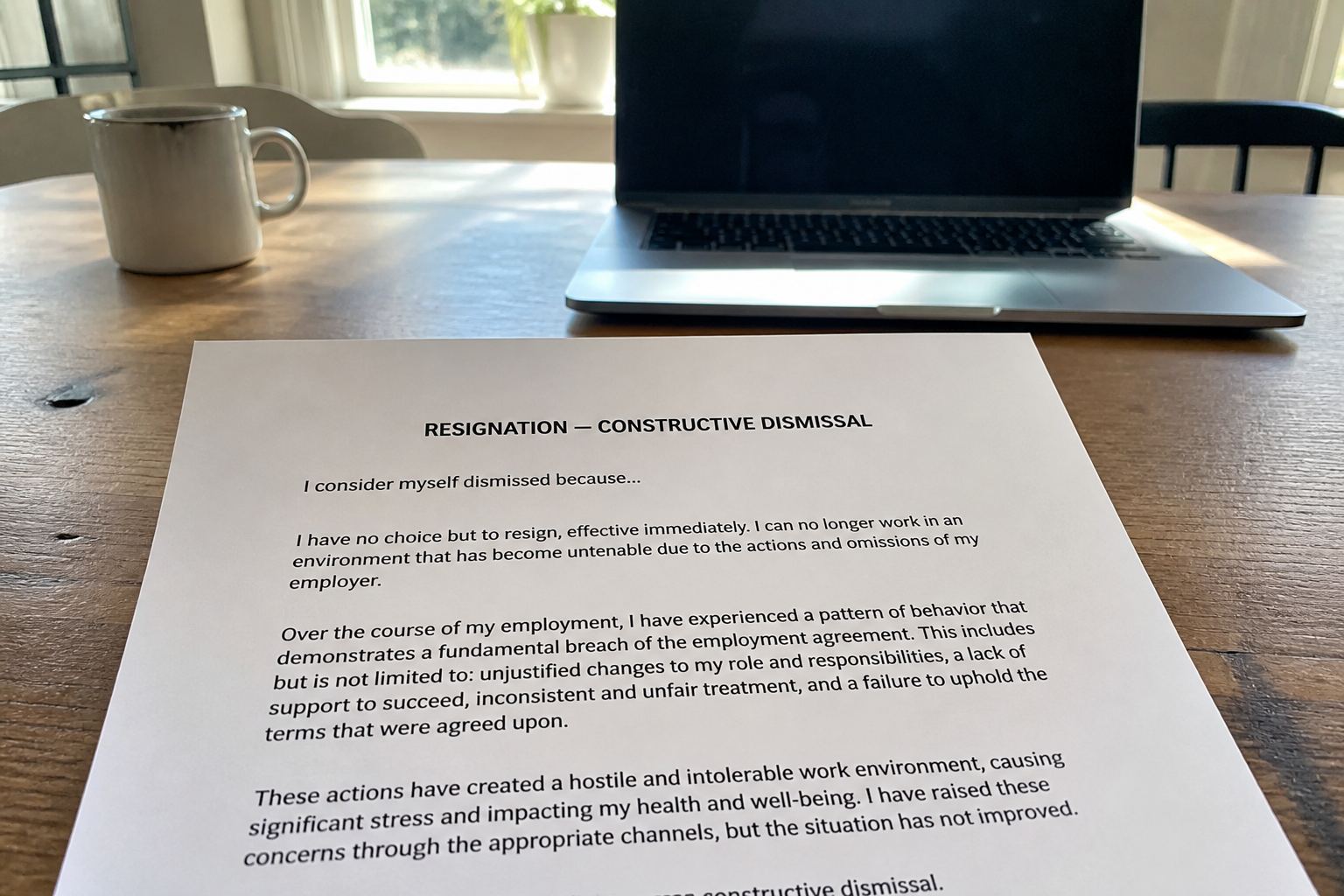
Ask most people when the clock starts running on a constructive dismissal claim, and they'll point to the moment their employer went too far, the final incident, the last straw that pushed them out the door. That's not the date that matters. The date that matters is the day your resignation takes effect, not the day of the breach that provoked it, and confusing the two is one of the easiest ways to miss a tribunal deadline.
Constructive dismissal, defined
Constructive dismissal happens when your employer commits a fundamental breach of your contract, something serious enough to go to the root of the relationship, and you resign because of it. It might be one dramatic event (a pay cut imposed without agreement, a demotion, a serious failure to deal with harassment) or a series of smaller breaches that add up. Either way, you're the one who ends the employment relationship. Legally, though, a tribunal treats your resignation as a dismissal by your employer, and it applies the same time limits and rules as it would to an outright sacking.
The effective date of termination is not the date of the breach
This is where people trip up. The breach might have happened weeks or months before you resigned. Maybe you tried a grievance first, maybe you waited to line up another job, maybe you simply needed time to work out what to do. None of that changes your tribunal deadline. What matters is your effective date of termination (EDT), which for a resignation is the date your resignation actually takes effect, whether that's your last day of work, the end of a notice period you served, or the date stated in your resignation letter if you left with immediate effect.
So the clock doesn't start when your employer did the thing that finally broke the relationship. It starts when you stop being their employee. If you worked a notice period after resigning, your EDT is the date that notice period ends, not the day you handed in your notice.
Applying the transitional rule from your EDT
From 1 October 2026, new regulations extend the standard tribunal time limit from three months less a day to six months less a day, and this covers unfair dismissal claims, the category constructive dismissal falls into for time-limit purposes. But the extension isn't universal from that date. A transitional rule says the longer limit only applies where the act or failure complained of happens on or after 1 October 2026. Earlier acts stay on the old three-month regime.
For constructive dismissal, the logical reading is that the relevant date is your EDT, since that's the date treated as the dismissal itself. If your EDT falls before 1 October 2026, you're almost certainly working to the shorter three-month-less-a-day limit. If it falls on or after that date, the six-month-less-a-day limit should apply. This hasn't been tested by a published tribunal decision as far as we can confirm, so if your resignation date sits close to that boundary, treat it carefully and check current guidance rather than assume.
| Your effective date of termination (EDT) | Time limit that applies |
|---|---|
| Before 1 October 2026 | 3 months less a day from your EDT (subject to Acas early conciliation extending it) |
| On or after 1 October 2026 | 6 months less a day from your EDT (subject to Acas early conciliation extending it) |
Either way, don't try to work this out in your head close to the deadline. Our employment tribunal deadline calculator is built to handle exactly this, including the 1 October 2026 transitional rule and the effect of Acas early conciliation on your specific dates.
Where Acas early conciliation fits in
Before you can lodge most tribunal claims, you need to contact Acas and go through early conciliation, with only narrow exemptions. From 1 December 2025 the maximum conciliation window is 12 weeks, up from 6. Contacting Acas pauses your limitation period while conciliation is underway, and you're guaranteed at least one more month after your Acas certificate is issued to lodge your claim, even if very little time was left when you started. In practice, your real deadline is your three or six month limit from your EDT, plus whatever extra time Acas conciliation adds. Get the date wrong and none of the rest of your case matters, because a tribunal generally has no discretion to hear a claim brought too late.
What this means if you're thinking about resigning
If you're still employed and weighing up whether to resign over your employer's conduct, work out your likely EDT before you act, not after. Once you know roughly when your resignation would take effect, you can work out which time-limit regime you'd sit under and how much room you'd have to bring a claim. Have a look too at our timeline of what changed and when under the recent employment law reforms, since several other rights are shifting on staggered dates around the same period, and it helps to see the whole picture rather than just this one deadline rule.
- Your constructive dismissal clock starts on your EDT, the date your resignation takes effect, not the date of the breach.
- Whether you get three months less a day or six months less a day from that EDT depends on whether it falls before or after 1 October 2026.
- Contacting Acas before that limit runs out pauses the clock and guarantees extra time after your certificate is issued.
Whatever else shifts as the rest of the reform programme rolls out in stages, this much won't change: your constructive dismissal claim is timed from the day your resignation takes effect, never from the day your employer's conduct pushed you towards resigning. What's genuinely still open is how tribunals will handle EDTs that sit right on the 1 October 2026 boundary, and whether further guidance clarifies that point before it's tested in a real case. Until then, if your dates are close to the line, treat the shorter limit as the safe assumption and check the current position before you rely on the longer one.
Quick answers
- How long do I have to claim constructive dismissal?
- The same filing clock as ordinary unfair dismissal: three months less a day if the EDT is before 1 October 2026, six months less a day if it is on or after. Acas pauses the clock.
- Do I still need two years' service?
- For an ordinary constructive unfair dismissal claim, yes, until the qualifying period is expected to fall to six months on 1 January 2027. Automatically unfair reasons have no qualifying period.
- When is the EDT if I resigned?
- Usually the date your resignation took effect, not the date of the last incident. Delay can also weaken the claim itself.