The time limit for a TUPE claim in 2026
Updated August 6, 2026
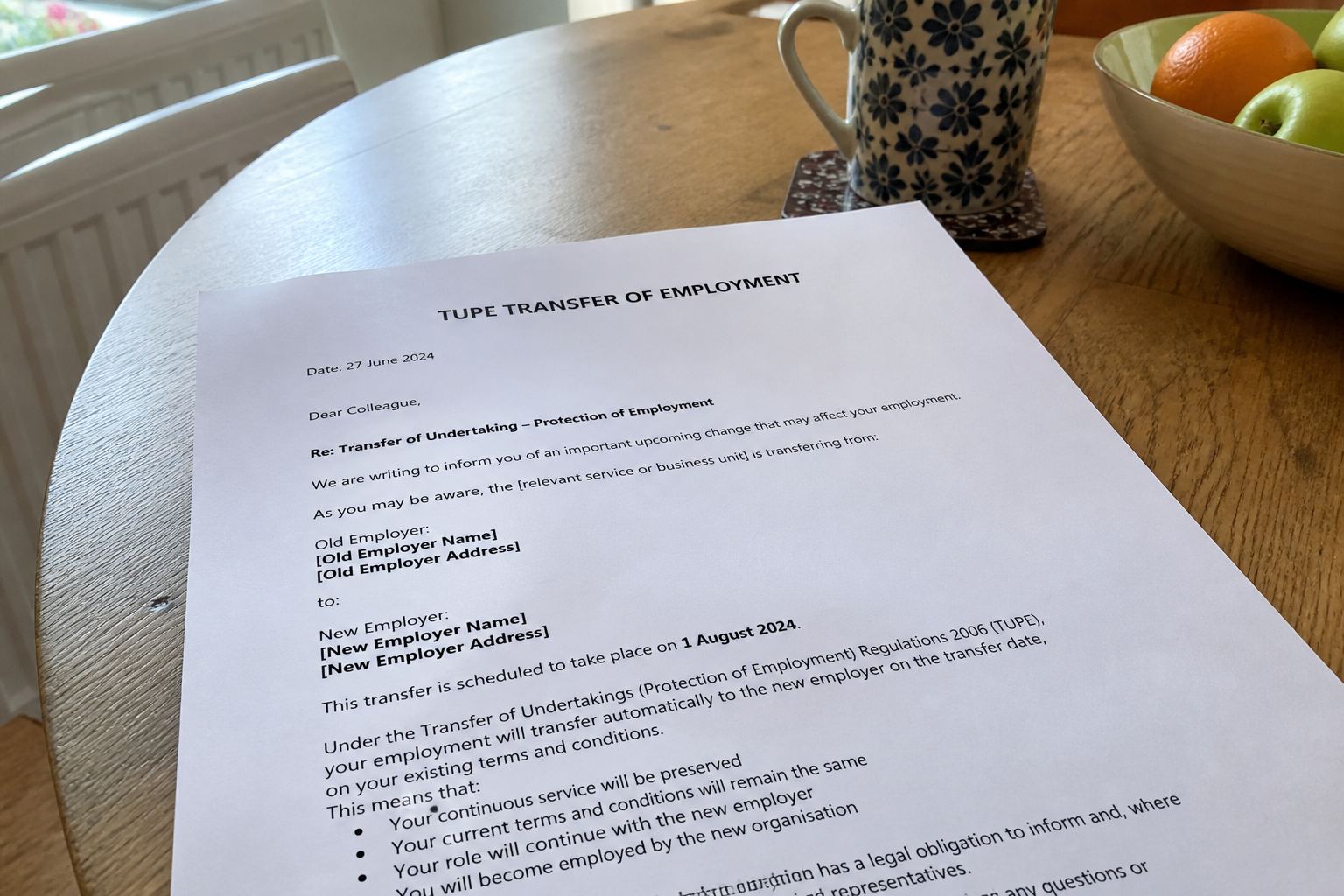
Most coverage of the new tribunal deadline treats it as one flat swap: three months becomes six months, done. For a TUPE claim it isn't that tidy. What decides which deadline applies to you is the date of the act you're complaining about, and that date is not always the date of the transfer itself.
TUPE and the two claims it allows
TUPE stands for the Transfer of Undertakings (Protection of Employment) Regulations 2006. It applies when a business, or part of one, changes hands through a sale, merger, or takeover, and also when a service moves from one contractor to another, or in-house to a contractor and back again. That second type, a service provision change, is common in outsourcing: cleaning, catering, and facilities contracts are classic examples. When TUPE applies, your employment transfers automatically to the new employer on your existing terms, and your continuity of service carries over as if you'd never changed employer.
The regulations give employees two main things to complain about: a failure to inform and consult employee representatives about the transfer, and dismissal connected to the transfer itself.
Failure to inform and consult
Both employers have a duty to tell affected employees' representatives that a transfer is happening, why, and what it means for them, and to consult properly where changes are planned. If that doesn't happen, or happens badly, affected employees, or their union or elected reps, can bring a claim. A tribunal can award up to thirteen weeks' pay per affected employee where the duty was ignored entirely.
The time limit for this kind of claim generally runs from the date the transfer actually takes place, not from the date consultation should have started or the date you personally found out it hadn't happened properly. That distinction matters more than most guides admit. Employees often only realise consultation was inadequate weeks after the transfer, by which point part of the clock has already run.
Automatic unfair dismissal connected to a transfer
If you're dismissed because of the transfer itself, rather than for a genuine economic, technical, or organisational reason involving changes to the workforce (the "ETO" defence employers rely on), the dismissal is automatically unfair. Here the trigger date is the effective date of termination, the same concept that governs any other unfair dismissal deadline: broadly, the date your notice period ends, or the date of dismissal itself if you were dismissed without notice.
That's a genuinely different starting point from the information and consultation claim above. A single transfer can produce two related claims with two different deadlines.
The October 2026 change and TUPE
From 1 October 2026, the standard tribunal time limit extends from three months less a day to six months less a day. TUPE claims are explicitly within scope, alongside unfair dismissal, discrimination, whistleblowing, and Working Time Regulations claims. But the extended limit only applies where the act or failure you're complaining about happens on or after 1 October 2026. An earlier act stays on the old three-month regime, even if you don't bring your claim until after the new rules are in force.
For TUPE that means the transfer date and the dismissal date can fall either side of the cut-off, particularly on a transfer that's announced, consulted on, and completed over several months. Our timeline of the Employment Rights Act 2026 changes sets out how the transitional rule works more generally; the same logic applies here, claim type by claim type.
| Claim type | What starts the clock | Limit if the act is before 1 Oct 2026 | Limit if the act is on or after 1 Oct 2026 |
|---|---|---|---|
| Failure to inform and consult | Date of the transfer | 3 months less a day | 6 months less a day |
| Automatic unfair dismissal (transfer-related) | Effective date of termination | 3 months less a day | 6 months less a day |
| Constructive dismissal after a transfer | Effective date of your resignation | 3 months less a day | 6 months less a day |
Constructive dismissal after a transfer
Sometimes the problem isn't a dismissal at all. The new employer changes your working conditions substantially for the worse after the transfer, and you resign because of it. That can be a constructive dismissal claim, and for time limit purposes it's treated like any other dismissal: the clock starts from the date your resignation takes effect, not from the date of the breach that pushed you to resign. If you're weighing that decision, get advice before you hand in your notice, because the timing of your resignation is what fixes your deadline.
Acas early conciliation still applies
You generally can't lodge any of these claims without contacting Acas for early conciliation first, with only narrow exemptions. That doesn't shorten your window: contacting Acas pauses the limitation clock while conciliation runs, for up to twelve weeks from 1 December 2025, and you're guaranteed at least a month after the Acas certificate is issued even if you contacted them late. TUPE cases often involve two employers and two different trigger dates, so work out your actual deadline properly rather than guessing. Our tribunal deadline calculator accounts for both the transitional rule and the Acas stop-the-clock effect.
What to do if you think you have a TUPE claim
- Work out which act you're complaining about, the transfer date, or your dismissal or resignation date, because that's what fixes your deadline, not the general date the reforms came into force.
- Contact Acas early conciliation as soon as you're seriously considering a claim. It's free, and it pauses your clock rather than using it up.
- Keep anything in writing about consultation, or the lack of it: emails, meeting invites, minutes, anything showing what you were and weren't told.
- If you're unsure whether your specific dates fall before or after 1 October 2026, check them with the deadline calculator rather than assuming either way.
My honest view is that the extension to six months is a real improvement for employees, especially in TUPE cases where it can take weeks just to work out which employer is actually liable for what. But I wouldn't treat the longer window as a reason to relax. Evidence about who said what during consultation fades fast, and memories soften in your former employer's favour long before six months is up. Six months is breathing room, not a target.
Quick answers
- How long do I have for a TUPE-related tribunal claim?
- Most TUPE claims follow the same 1 October 2026 split as other tribunal claims: three months less a day before, six months less a day on or after, from the relevant act. Acas pauses the clock.
- Does objecting to the transfer pause limitation?
- No. Objection and consultation are not a substitute for Acas.
- Is a TUPE dismissal automatically unfair?
- A dismissal by reason of the transfer is unfair unless an economic, technical or organisational reason entailing changes in the workforce applies. Get advice on the facts.