The April 2026 wage floor
Updated 13 November 2026
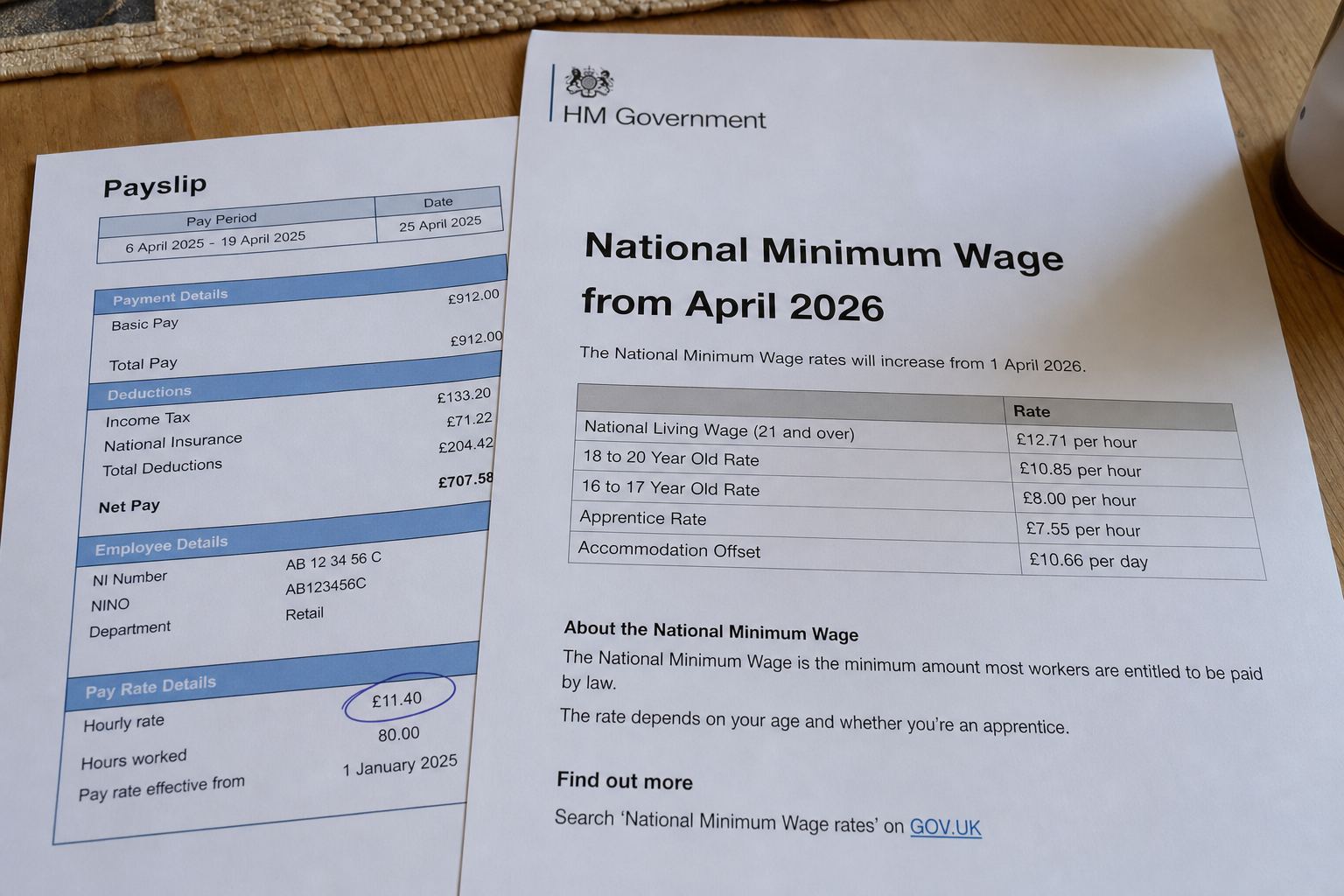
Minimum wage is an hourly floor by age, not a monthly salary promise. The only benefit that can count toward it is living accommodation, and even that is capped.
The April 2026 rates
These are the statutory rates from 1 April 2026, as implemented after the Low Pay Commission advice. They change each April. If you are reading this after the next uprating, use gov.uk, not this paragraph.
| Rate | Who it is for | From 1 April 2026 |
|---|---|---|
| National Living Wage | 21 and over | £12.71 an hour |
| National Minimum Wage | 18 to 20 | £10.85 an hour |
| National Minimum Wage | 16 to 17 | £8.00 an hour |
| Apprentice rate | Apprentices in the first year, or under 19 | £8.00 an hour |
| Accommodation offset | Daily cap if the employer provides housing | £11.10 a day (£77.70 a week) |
A salary that looks fine on an offer letter can still be below the floor once you divide by the hours you actually work, including time you are required to be on site. Sleep-in and travel-time arguments are fact-specific; do not take a viral post as the rule.
Past rates, 2022 to 2026
If you are checking an old payslip or a back-pay claim, use the rate that applied on the date you were paid. Before 1 April 2024 the National Living Wage was for workers aged 23 and over, with a separate rate for ages 21 to 22.
| Period | National Living Wage | 21 to 22 | 18 to 20 | Under 18 and apprentice |
|---|---|---|---|---|
| Apr 2025 to Mar 2026 | £12.21 (21 and over) | as NLW | £10.00 | £7.55 |
| Apr 2024 to Mar 2025 | £11.44 (21 and over) | as NLW | £8.60 | £6.40 |
| Apr 2023 to Mar 2024 | £10.42 (23 and over) | £10.18 | £7.49 | £5.28 |
| Apr 2022 to Mar 2023 | £9.50 (23 and over) | £9.18 | £6.83 | £4.81 |
The rates from 1 April 2027 have already been announced: £13.21 an hour for 21 and over, £11.27 for 18 to 20, and £8.31 for under-18s and apprentices. Source: gov.uk minimum wage rates.
Who it covers
The floor applies to workers, not only employees. That is why the worker versus employee distinction matters on this site. Genuine self-employment is outside it. Tips do not count toward the minimum, and the separate rules on how employers must pass on and share tips sit on top of it. Unpaid trial shifts that are actually work are a common failure. The apprentice rate (£8.00 an hour from 1 April 2026) applies if you are under 19, or 19 or over and in the first year of your apprenticeship. Once you are 19 or over and past that first year, you must get at least the rate for your age.
The accommodation offset
Housing is the only benefit that can be used in the minimum-wage calculation. Food, a travel card, or a phone do not count. If the employer charges more than £11.10 a day, the excess is taken off pay that counts toward the wage. If housing is free, the offset is added. That is how a cheap-looking room becomes an underpayment. Confirm the current offset on gov.uk accommodation rates.
What to do next
Keep rotas and payslips. The Fair Work Agency was set up on 7 April 2026. HMRC still carries out minimum wage enforcement on its behalf during 2026/27, and that work is due to move fully into the Agency in April 2027; a tribunal deduction claim is a second door and has its own deadline. Use the official calculator on gov.uk rather than a spreadsheet you were sent in a group chat.
Quick answers
- What is the National Living Wage in 2026?
- £12.71 an hour for workers aged 21 and over, from 1 April 2026. Confirm on gov.uk if you are past the next April change.
- Do tips count?
- No. Tips do not count toward National Minimum Wage or National Living Wage.
- Does this apply to workers as well as employees?
- Yes. The wage floor is a worker right. Status still matters for other claims.