Reporting your employer to the Fair Work Agency: what it can and can't do yet
Updated 24 September 2026
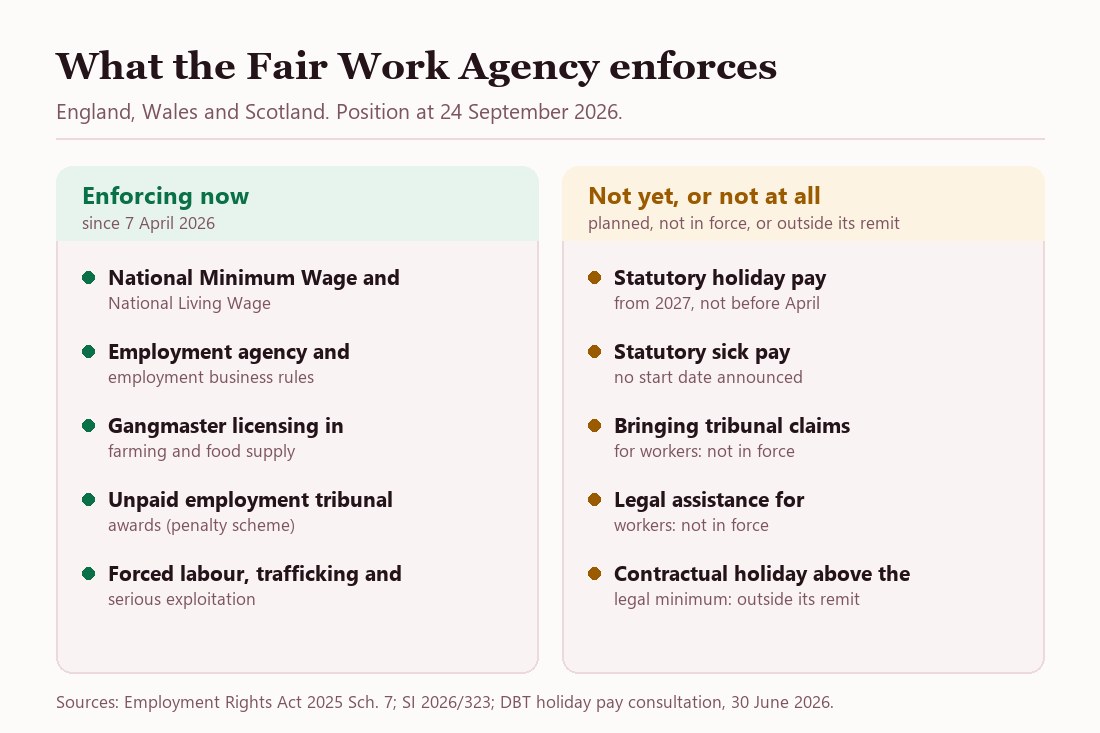
The Fair Work Agency was sold as a single place to go when your employer breaks the rules. Five and a half months in, it is that for some problems and not yet for others. If you are being paid under the minimum wage, it is the right door and it costs you nothing. If your problem is unpaid holiday, missing sick pay or anything that needs a tribunal claim, reporting it to the agency will not be enough on its own. This page sets out what the agency can act on today, how to report, what happens next, and what you still need to do yourself.
What is the Fair Work Agency?
The Fair Work Agency, often shortened to FWA, is an executive agency of the Department for Business and Trade. It was set up on 7 April 2026 under Part 5 of the Employment Rights Act 2025. According to the government's factsheet on the agency, it has no separate legal identity of its own: the Act gives the enforcement powers to the Secretary of State, and the agency's enforcement officers use them in practice.
It took over work that used to be split between four bodies:
- HMRC's National Minimum Wage unit, which investigated underpayment of the minimum wage and, under the new arrangement, still does that work on the agency's behalf.
- The Employment Agency Standards Inspectorate, which policed recruitment agencies and employment businesses.
- The Gangmasters and Labour Abuse Authority, which licensed labour providers in farming and food and investigated serious exploitation.
- The Director of Labour Market Enforcement, which set the overall enforcement strategy.
If someone tells you to "report it to HMRC", they are not entirely wrong. The responsibility now belongs to the Fair Work Agency, but the gov.uk complaint page says HMRC enforces the National Minimum Wage on the agency's behalf, and the complaint form still runs on HMRC's tax.service.gov.uk site. It is one route with two names on it. The contact details on the agency's gov.uk organisation page are the current ones.
What can it enforce right now?
This is the part that is easy to get wrong. The Act lists everything the agency may eventually enforce in Schedule 7, but only part of that list has been switched on. The commencement regulations (SI 2026/323) brought the enforcement powers into force on 7 April 2026 for a defined set of laws. In plain terms, that set covers:
- The National Minimum Wage and National Living Wage, including your right to see your pay records, the employer's duty to keep them, and protection from being punished for asserting the right.
- Employment agencies and employment businesses, under the Employment Agencies Act 1973 and the regulations made under it.
- Gangmaster licensing for businesses that supply labour to the agriculture and food sectors.
- Unpaid employment tribunal awards and settlement sums, through the penalty scheme in Part 2A of the Employment Tribunals Act 1996.
- Forced labour, slavery and trafficking offences involving workers, and fraud by abuse of position against a worker.
What is not on that list yet: statutory holiday pay, statutory sick pay, and the power to take a case to a tribunal for you. Those are covered further down.
The gov.uk complaint form also accepts complaints about working time limits, such as the 48-hour average week, and the government's pay and work rights page explains that some of those issues go to the Health and Safety Executive rather than the agency. That page lists which body deals with which problem, so check it if you are unsure where yours belongs.
How to report your employer, step by step
For pay problems, the route is the pay and work rights complaint form on gov.uk. It covers the minimum wage, employment agencies, working time limits and the agricultural minimum wage.
- Check the numbers first. Work out your hourly pay for each pay period: total pay for the period, minus anything the rules do not count, divided by the hours you actually worked, including time you had to be there. Our page on National Minimum Wage rates has the current rates by age, and gov.uk has an official calculator.
- Gather what you have. Payslips, rotas, clocking-in records, messages about hours, and anything showing deductions for uniforms, equipment or training. Screenshots of a shift app are fine. You do not need a complete set to complain.
- Fill in the form. Give the employer's name and address, what happened, and the dates. If you do not want the employer to be told who complained, say so on the form. The gov.uk page invites you to do exactly that.
- Decide about your own claim at the same time. A complaint to the agency does not pause any tribunal deadline. If you may want to bring your own claim, start Acas early conciliation before your time limit runs out.
- Keep a note of what you sent and when. If your employer treats you badly after you complain, that record matters.
A few practical points from the gov.uk page are easy to miss. You can report an employer you no longer work for. Someone else, such as a family member or a union rep, can complain for you, though the agency will ask for your permission. And you cannot use the complaint form for a minimum wage problem if you have already started tribunal action about that same issue.
If you are struggling with the form, the Acas helpline is on 0300 123 1100, Monday to Friday, 8am to 6pm, and it offers free translation.
Serious abuse or exploitation: a different route
If the problem is worse than underpayment, for example your passport has been taken, you are being threatened, you cannot leave, or you owe a debt to the person who found you the job, use the separate exploitation route. The agency's contact page, updated on 17 September 2026, lists three ways in:
- the online reporting form for serious abuse or exploitation at work, which the agency says is one of the quickest routes;
- email to contact@fairworkagency.gov.uk;
- a free phone line on 0800 432 0804, from 9am to 5pm, Monday to Friday, with voicemail outside those hours.
You do not have to give your name, though the agency says it can support you better if it can contact you. The phone line is not an emergency number. If you are in immediate danger, call 999.
The page mentions people on sponsored work visas, such as the Skilled Worker visa, specifically. If your visa depends on your employer, that makes it harder to complain, and it is one of the situations the exploitation route was built for.
What happens after you report
For minimum wage underpayment, the agency uses the system HMRC used, now set out in sections 103 to 115 of the 2025 Act. If an enforcement officer finds you were underpaid, the agency can issue a notice of underpayment. That notice requires the employer to pay the arrears to the workers affected and a penalty to the government.
The penalty settings for the minimum wage, as the government described them in its holiday pay consultation of 30 June 2026, are:
- 200% of the arrears owed, per worker;
- a maximum of £20,000 per worker;
- a minimum of £100 per case;
- and the penalty is effectively halved if the employer pays the arrears and half the penalty within 14 days.
The penalty goes to the government, not to you. What you get is the arrears. The investigation can also look at the whole workforce, not only your complaint, which is why one report can end with dozens of colleagues being repaid.
Employers who are penalised are generally named. The first naming round since the agency took over was published on 3 September 2026: the government named nearly 660 employers, said more than £4 million had been repaid to over 27,000 workers, and put the penalties at £7 million.
The agency has other tools too. Officers can demand documents, enter premises, and, for more serious or repeated breaches, ask an employer to sign a labour market enforcement undertaking or apply to a court for an enforcement order. Breaking an order is a criminal offence.
The gov.uk complaint page gives no timescale for an investigation. That is another reason not to rely on it for anything with a tribunal deadline attached.
Holiday pay and sick pay: coming, but not yet
This is the biggest gap between the promise and the present. The Act does give the agency power over holiday pay and statutory sick pay, but neither has been commenced.
Holiday pay. The government's consultation, which ran from 30 June to 22 September 2026, says the Fair Work Agency will enforce statutory holiday pay "from 2027". The government's employer guidance adds that it will not start before April 2027. What the government proposed:
- the agency could look back up to six years, which is the most the Act allows;
- but it could not enforce any underpayment from before 18 December 2025, when the Act received Royal Assent;
- penalties would match the minimum wage: 200% of arrears, capped at £20,000 per worker;
- an employer who repays everything before an investigation starts would not normally be penalised;
- employers could in future be named for holiday pay underpayment too, which the consultation asked about.
The agency would enforce only the statutory minimum under the Working Time Regulations: 5.6 weeks for most people, pro-rated for part-timers. Any extra holiday in your contract stays a matter for a tribunal or the civil courts. Our guide to holiday pay explains how the statutory amount is worked out.
One change has already landed that will help later. Since 6 April 2026 employers have had to keep records adequate to show they have complied with holiday and holiday pay rules, and keep them for six years, under regulation 16B of the Working Time Regulations. If you are owed holiday pay from this year, those records should exist when the agency's powers arrive.
Statutory sick pay. Sick pay from the first day of illness has applied since 6 April 2026, but no date has been announced for the agency to enforce it. For now, raise an SSP problem with your employer first, and call Acas if it is not sorted out.
Until then, holiday pay you are owed is recovered by your own claim, usually as an unlawful deduction from wages or under the Working Time Regulations. Both have tribunal deadlines.
Will the agency take your case to a tribunal?
Not yet. Section 116 of the 2025 Act gives the government a power to bring proceedings in an employment tribunal in place of a worker, where the worker has a right to claim but it appears they are not going to. Section 117 lets it give legal advice and assistance. Both are shown as not yet in force on legislation.gov.uk, and the commencement regulations for 7 April 2026 left them out.
When section 116 does start, there are limits built in. It does not apply to a matter already covered by a notice of underpayment. Any award would still be made to the worker, not to the government. And the worker could appeal alongside the government.
So for now, if you need a tribunal to decide something, you bring the claim yourself, with help from Acas, a union, or a solicitor.
Report to the agency, go to a tribunal, or both?
These are two separate routes, and you can use both. The government's consultation is clear that state enforcement does not replace your right to claim. But you cannot recover the same money twice, and a tribunal may choose not to hear a claim while the agency is investigating the same thing.
| Fair Work Agency | Your own tribunal claim | |
|---|---|---|
| Cost to you | Free | Your time, and advice costs if you pay for help |
| How far back | Up to six years for the minimum wage | Three months, or six for acts on or after 1 October 2026, plus a two-year backstop on most deduction claims |
| Who controls it | The agency decides whether and how to act | You do |
| What it covers today | Minimum wage, agency rules, gangmasters, exploitation | Almost any employment right, including holiday pay and dismissal |
| Pauses a deadline? | No | Acas early conciliation pauses the tribunal clock |
The practical rule: if your problem is only minimum wage arrears and you are well outside the tribunal window, the agency may be your best route, because its look-back is far longer. If anything else is at stake, such as a dismissal, discrimination or holiday pay, protect your own deadline with Acas and report to the agency as well. The tribunal deadline calculator applies the 1 October 2026 switch from three months to six.
If your employer punishes you for complaining
You are protected. Under section 23 of the National Minimum Wage Act 1998, a worker has the right not to suffer a detriment for taking action to secure the minimum wage. For employees, section 104A of the Employment Rights Act 1996 makes a dismissal automatically unfair if the main reason is that action was taken, by you or on your behalf, to enforce the right. That covers a complaint to the agency, and no qualifying period of service is needed.
A detriment or dismissal claim is your own claim with its own deadline, so start Acas early conciliation promptly. If you have been dismissed, our first steps after a dismissal checklist sets out what to do in the first few days.
If a tribunal award has not been paid
If you have already won at a tribunal, or reached an Acas settlement, and the employer has not paid, the agency can help here too. Gov.uk's guidance on what to do if you win your case says you can ask the Fair Work Agency to contact the employer and tell them to pay, and the penalty scheme for unpaid awards is one of the laws it now enforces. The same guidance sets out the court enforcement routes if that does not work.
This page is general information for England, Wales and Scotland, not legal advice. For your own situation, speak to Acas, a solicitor, or your union.
Quick answers
- Can I report my employer to the Fair Work Agency anonymously?
- You can ask for the employer not to be told who complained. The gov.uk pay and work rights complaint form has a place to say so. For serious abuse or exploitation, the Fair Work Agency says you do not have to give your name at all, although it can help you more if it can contact you.
- Can the Fair Work Agency get my unpaid holiday pay back?
- Not yet. Holiday pay is due to come under the agency from 2027, and the government has said not before April 2027. Until then, holiday pay is enforced by your own claim: talk to Acas, protect your tribunal deadline, and keep your payslips and rotas.
- Does reporting to the Fair Work Agency stop my tribunal time limit?
- No. Only Acas early conciliation pauses the tribunal clock. A complaint to the Fair Work Agency runs separately, so if you might want to bring your own claim, contact Acas before your deadline even while the agency is looking at your complaint.
- Can I report an employer I no longer work for?
- Yes. The gov.uk complaint page says you can report an employer even if you no longer work there. For minimum wage underpayment the agency can look back up to six years, which is much longer than a tribunal claim allows.
- Will the Fair Work Agency take my case to a tribunal for me?
- Not at the moment. The Employment Rights Act 2025 gives it a power to bring tribunal proceedings in place of a worker and to give legal assistance, but those sections are not yet in force. For now it uses notices of underpayment, penalties and naming.