The time limit for a Working Time Regulations claim
Updated August 6, 2026
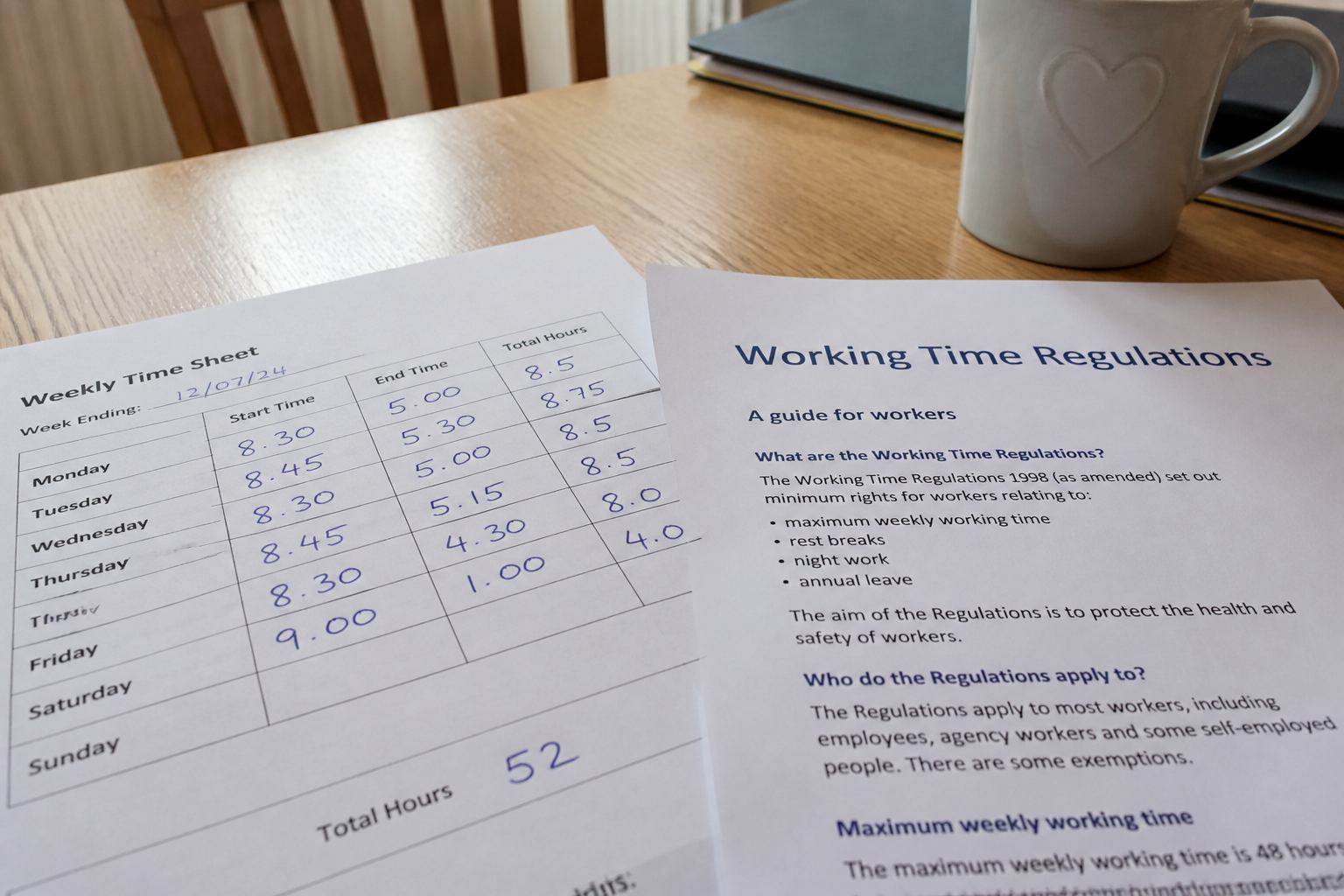
Your holiday pay landed short again this month, about forty pounds under what four days off should have paid you, and you've decided to let it go rather than make a fuss. That decision has a clock running on it, whether you've started it or not.
What counts as a Working Time Regulations claim
The Working Time Regulations 1998 cover more than most people realise. They're the reason you're entitled to a minimum amount of paid holiday, to daily and weekly rest, to an in-work break if your shift runs long enough, and to a 48-hour weekly working limit unless you've signed a valid opt-out. If your employer has short-changed your holiday pay, cancelled your breaks without giving you the time back, or quietly expects you over 48 hours a week without ever asking you to opt out, that's a breach you can take to an employment tribunal.
Whether you should, and how strong the claim is, depends on your circumstances. But the deadline for doing it doesn't wait for you to decide.
The deadline, and why the date of the breach decides which one applies
For years the standard time limit for most tribunal claims, including Working Time Regulations claims, has been three months less a day from the relevant date. From 1 October 2026, new regulations extend that to six months less a day. Working Time Regulations breaches are explicitly named as one of the claim types this extension covers, alongside unfair dismissal, discrimination, whistleblowing and TUPE claims.
The catch is the transitional rule. The longer six-month limit only applies where the act or failure you're complaining about happens on or after 1 October 2026. If your employer failed to pay your holiday correctly, or skipped your rest breaks, before that date, you're still on the old three-month clock, even if you only get round to dealing with it afterwards. It's the date of the breach that matters, not the date you sit down to work it out. Our timeline of what changed and when sets out the wider context if you want to check where a particular right or reform sits.
Where a breach happens more than once, say you're routinely denied your rest break every week rather than just the one time, working out exactly which date starts your clock gets harder. The safest working assumption is to count from the most recent occurrence, but whether earlier instances can be pulled in too depends on the specific facts and isn't something to guess at. Our tribunal deadline calculator applies the correct regime for the date you give it, but it can't tell you which date is the right one to enter if your situation involves repeated breaches. That judgement call is worth getting checked.
Unpaid holiday pay and the "series of deductions" complication
Unpaid holiday pay is unusual because it can be pursued two different ways, and they don't run on the same rules. You can bring it as a direct Working Time Regulations complaint, which is the route covered by the extension above. Or you can bring it as an unlawful deduction from wages claim, treating the missing holiday pay as money your employer should have paid you and didn't.
The wages route has its own long-standing feature: the "series of deductions" rule. Rather than only being able to claim for the single most recent shortfall, you may be able to treat a run of similar underpayments as one continuous series, with your time limit running from the date of the last deduction in that series rather than the first. In principle that can let you reach back further than a single three- or six-month window would suggest. In practice, what breaks a series (a gap between underpayments, a change in the type of deduction) has been argued over in the courts more than once, and the rules on how far back you can go are genuinely fiddly. There's also a separate backstop limiting how far a deductions claim can reach back, on top of the ordinary time limit. Don't take a confident view of your own case on this point without checking current guidance or getting it looked at, because it's an area where getting the detail wrong costs you money.
It also isn't yet clear whether the wages-deduction route benefits from the same six-month extension as a direct Working Time Regulations complaint, since the 2026 regulations name Working Time Regulations breaches specifically rather than unlawful deduction claims generally. If you're relying on the deductions route, check the current time limit that applies to it before you assume you have the longer window.
| Route | What it covers | Deadline to watch |
|---|---|---|
| Direct Working Time Regulations claim | Rest breaks, daily/weekly rest, the 48-hour limit, and holiday pay | Six months less a day for breaches from 1 October 2026 onwards; three months less a day for anything earlier |
| Unlawful deduction from wages claim | Unpaid holiday pay only, framed as missing wages | Its own time limit and "series of deductions" rules apply; check whether the 2026 extension reaches this route before relying on it |
Acas early conciliation still comes first
Whichever route applies, you generally can't lodge a tribunal claim without going through Acas early conciliation first, other than in a narrow set of exempt situations. Contacting Acas pauses your limitation clock while conciliation is underway, and you're guaranteed at least one more month after your certificate is issued to lodge your claim, even if very little time was left when you started. Since 1 December 2025, early conciliation can run for up to twelve weeks rather than six, which gives it more room to resolve things, or more time added onto your eventual deadline if it doesn't. Running your dates through the deadline calculator once you've contacted Acas will show you where that leaves you.
Write down today's date next to the most recent missed break, cancelled rest day, or short holiday payment, then start early conciliation with Acas rather than waiting for things to settle down, because that's the step that stops your clock running.
Quick answers
- How long do I have to claim under the Working Time Regulations?
- Usually three months less a day if the act was before 1 October 2026, or six months less a day if it was on or after. Acas pauses the clock.
- Does unpaid holiday use this deadline?
- Holiday-pay claims can sit under working time and unlawful deduction rules. Do not assume one clock covers both.
- Does a grievance about hours pause the deadline?
- No.