Fire-and-rehire isn't banned. Here's what's actually changed
Updated 28 September 2026
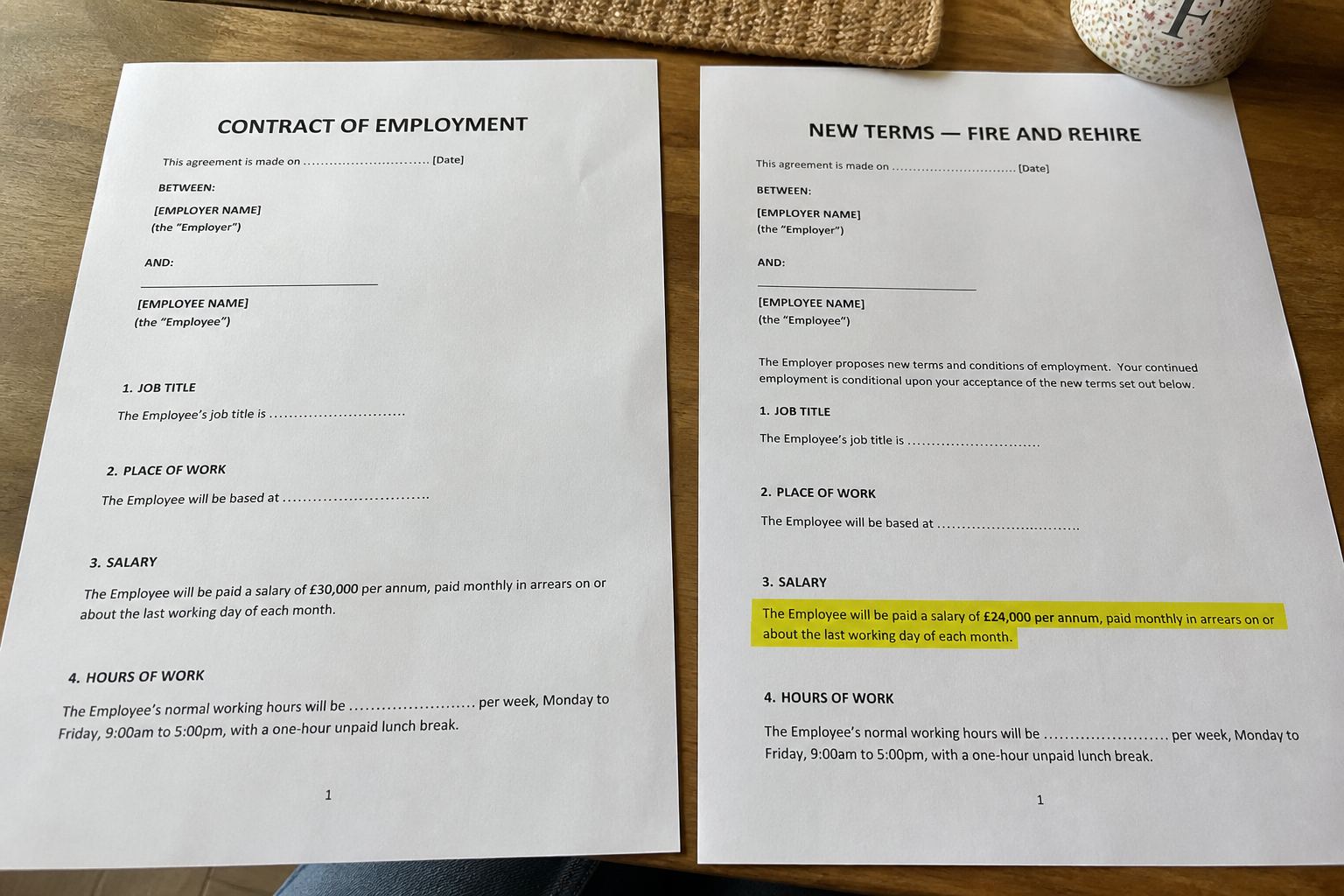
From January 2027, dismissing staff to force through cuts to pay or time off, or changes to the number of hours they work or to pensions, will be automatically unfair in most cases. Fire-and-rehire itself isn't being banned outright: an employer will keep a narrow defence where the change was needed to deal with serious financial difficulties. That's a much tighter path than the general fairness test dismissals are judged against now.
What fire-and-rehire actually means
Fire-and-rehire, sometimes called dismissal and re-engagement, is a tactic employers use to change contract terms an employee won't agree to. Instead of negotiating, the employer terminates the existing contract and offers a new one on worse terms, often with little time given to weigh it up. Refuse the new contract and you're out of a job. Accept it and you keep working, just for less pay or under a worse rota.
It has always been legally possible in principle, because an employer can dismiss for "some other substantial reason" under unfair dismissal law, provided the dismissal is fair in all the circumstances. That's the door reform is trying to narrow, not shut.
Why it was targeted
The practice drew sustained political attention after high-profile cases where large numbers of staff were dismissed and told to reapply on inferior contracts, sometimes with almost no warning at all. Whatever the specific facts of any one dispute, the pattern worried lawmakers: employees with years of service losing their terms overnight, with the tribunal system offering redress only after the event, if at all.
The government's response builds directly on machinery that already existed rather than starting from nothing.
The existing statutory code of practice
A statutory Code of Practice on dismissal and re-engagement has applied since mid-2024. It doesn't ban fire-and-rehire. It sets out how an employer should behave if it's considering it: consult properly, share information, explore alternatives, and treat dismissal and re-engagement as a genuine last resort rather than a first move in a pay negotiation. Tribunals can already apply an uplift of up to 25% to certain awards where an employer unreasonably fails to follow the Code. That uplift is the enforcement teeth the Code always had, and the newer restrictions sit on top of it rather than replacing it.
What the newer restrictions add
The Employment Rights Act 2025 goes further than a code an employer can weigh up and sometimes choose to ignore. It makes it harder to treat an employee's refusal to accept worse terms, on its own, as a fair reason to dismiss. Where you are dismissed because you would not agree to a "restricted variation", or so the employer can re-employ you or someone else on those terms, the dismissal becomes automatically unfair in most circumstances, rather than something weighed case by case against a general fairness standard. A restricted variation is a cut to pay or to time off, a change to the targets or output measures your pay depends on, to pensions or to the number of hours you work, certain changes to shifts, or a term letting the employer make any of those changes without your agreement. Other changes, such as a new place of work, are not covered by the automatic rule.
The Act received royal assent on 18 December 2025 and commences in stages. The government's implementation timeline, updated on 25 September 2026, lists the fire and rehire protections among the measures taking effect in January 2027, without a specific day. Until then, the Code of Practice and the ordinary fairness test apply, and an ordinary unfair dismissal claim usually needs two years' service. That falls to six months where employment ends on or after 1 January 2027, and the new automatic protection will need no minimum service. Our timeline of what's changed under the Employment Rights Act tracks the other dates.
The financial difficulties exception
The restriction isn't absolute. Under the new section 104I of the Employment Rights Act 1996, an employer other than a local authority avoids automatic unfairness only if it shows both of these:
- the reason for the change was to eliminate, prevent, significantly reduce or significantly mitigate financial difficulties that, at the time of the dismissal, were affecting, or were likely in the immediate future to affect, its ability to carry on the business as a going concern (for public sector employers, the financial sustainability of their statutory functions)
- in all the circumstances, it could not reasonably have avoided the need to make the change
Local authorities have a separate test tied to a government intervention direction. Even where the exception applies, the dismissal is not automatically fair: the tribunal still decides fairness, and must consider any consultation with you or your union or representatives, and anything you were offered in return for agreeing. A bare assertion of "commercial reasons" won't do. The bar sits closer to real financial difficulty than to ordinary cost-cutting.
Comparing the two regimes
| Question | Code of Practice (since mid-2024) | Newer statutory restriction |
|---|---|---|
| Does it ban fire-and-rehire? | No, it sets expected process | No, but it narrows when it's lawful |
| What happens if an employer ignores it? | Tribunal can uplift certain awards by up to 25% | Dismissal can be automatically unfair |
| Is there a way round it? | Follow the Code's consultation steps | Serious financial difficulties, narrowly applied |
If you think you're facing it
If your employer has threatened to dismiss and re-engage you on worse terms, the effective date of your dismissal, whenever that turns out to be, is what starts the clock on any tribunal claim. Working out that clock, and the Acas early conciliation step you'll almost certainly need to go through first, is exactly what our tribunal deadline calculator is built for, including how the rules differ depending on whether your dismissal falls before or after the October 2026 transitional date. Keep a written record of what you were told and when, and don't sign a new contract under pressure without reading it properly first.
This page explains the general shape of the fire-and-rehire restrictions as currently understood. It isn't a substitute for advice on your specific contract, your employer's stated reasons, or the commencement date that applies to your case, and because the new provisions are not due to start until January 2027, check the final position when they do.
Quick answers
- Is fire-and-rehire banned?
- No. From January 2027, dismissing people to force through cuts to pay or time off, or changes to the number of hours they work or to pensions, will be automatically unfair in most cases, with a narrow financial-difficulties defence, and no minimum service will be needed. Until then, the ordinary fairness test and the Code of Practice apply, and an ordinary claim usually needs two years of service.
- Does the 2024 Code still matter?
- Yes. Tribunals can still uplift awards by up to 25 percent for unreasonable failure to follow the Code of Practice on dismissal and re-engagement.
- Should I start Acas if I am being re-engaged on worse terms?
- Yes, if a dismissal or detriment clock is running. Consultation does not pause limitation.